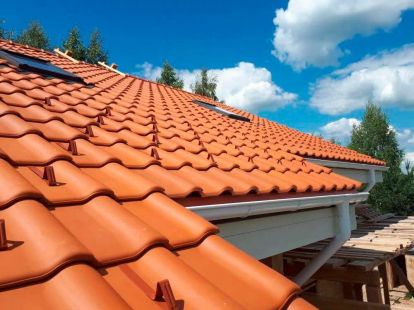
Монтаж кровли из керамической черепицы
Ceramic Roof Tiles in Phuket have come to us from the distant past; even the ancient Romans fired clay tiles and covered the roofs of their houses with them. Since those times, ceramic tiles have occupied a special place in European architecture. Now, this roofing material imitates various shapes and different colors. Thanks to modern developments, tiles can give a building a historical or contemporary look and protect your home from weather conditions with a guarantee of at least 30 years.
**Production of Ceramic Roof Tiles**
The main raw material for tile production in Thailand is clay with low marl content. Natural ceramic tiles also include additional components (quartz sand, crushed brick, iron) to improve the material. During the preparation stage, the ingredients are crushed and mixed, then the desired tile shape is formed under a press.
The next stage is drying the product for about 24 hours, where 20% moisture is reduced to 1.5%. The formed tiles are then fired in a kiln at a temperature of 900-1200°C. This heat treatment gives the material a porous structure. An equally important technological process affecting service life and quality is slow cooling. Finished ceramic tiles differ in shape and color.
**Types of Ceramic Roof Tiles**
Ceramic roof tiles in Phuket can be divided into types. During creation, the material is colored using coatings such as engobe or glaze. Engobed ceramic tiles are covered with a thin layer of clay, thanks to which the matte color of the coating gains resistance to sunlight. Glazed tiles acquire a bright color and shine; the glaze better repels dirt and prevents the spread of mold. Natural ceramic tile is not colored and has a natural reddish-brown color.
Tiles also differ in their shape, with each tile shape having its own name, often characterizing its origin. In addition to classic forms, manufacturers also create their own modern offerings. The main types of ceramic tiles are: German, Spanish, Beaver Tail, Wave, Flat, Diamond, Monk and Nun, Two-Locked, Groz, Monastic.
It's worth noting modern tiles such as glass tiles (as an alternative to ceramic) and non-standard sized tiles. Glass tile was developed in Sweden in 2010 and won an award as the best new product of the year. Such tiles are made in two variants - entirely from glass or from fiberglass. In weight, the tile is no different from ordinary ones, can be used for attic lighting, easily self-cleans from snow (snow melts from roof heating), and also, a glass roof, heated by the sun, can warm a house.
Non-standard, large-sized tiles (300x480 mm) are more convenient for laying, but in weight, large-format tiles are heavier than ordinary ones. To cover 1 m², only 10-12 pieces are needed, instead of 14-15 standard-sized tiles.
**Advantages**
* Tiles are heavier than other roofing materials, thanks to which better thermal and acoustic parameters are achieved.
* In summer, the roof protects the interior from heat, and in winter from heat loss.
* Tiles effectively suppress the noise of rain and hail; in case of hail damage, tiles can be easily replaced.
* Since the product is 100% natural, ceramics ensure a healthy building microclimate.
* Traditional ceramic roofing has high resistance.
* The strength of tiles is rated for 100 years or more.
* The material is used on all types of roofs - from pitched to turreted, provided the tile is selected correctly.
* The colors of ceramic tiles are stable and do not change due to weather conditions.
**Design**
When it comes to choosing design and color, ceramic tile is unbeatable. Among the tiles, it is easy to choose according to your preferences for color, pattern on the tile, size, and shape. The surface of the material can be glossy or matte depending on the coating, with standard or bright colors.
An interesting solution is combining different shades in the design. Also, modern manufacturers have begun producing tiles with mixed colors, for example, brown with red, which looks very interesting.
Ceramic tiles by Braas (formerly RuppCeramika) particularly stand out in the construction market of Phuket, Thailand, not only for their quality but also for their design - this is a unique style and luxurious shades of precious stones.
**Installation**
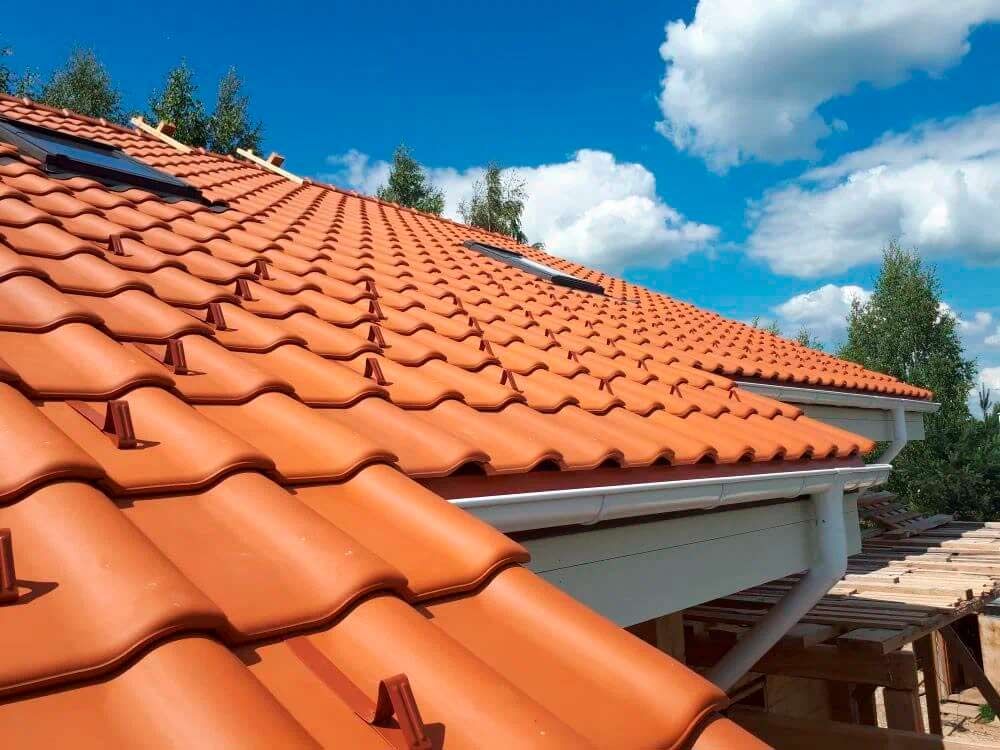
When planning to cover a roof with ceramic tiles, ensure your structure is strong enough to withstand the weight, which can reach 50 kg/m² or more. It is not possible to install ceramic tiles on a newly built wooden house; you should wait until the house "settles" and start work after about a year. The next task is to determine the roof pitch. The optimal pitch angle is 45 degrees, the minimum pitch angle is 15 degrees. If the roof has a complex shape, it is worth studying all types of ceramic tiles, as each has its own fastening peculiarities, which can affect the roof's resistance to damage.
Tiles are fastened in two ways: by the side - the lock runs along the long side of the tile, or by the top of the tile. Both types of fastening are similar; in this case, the tile locks overlap each other. There are slabs where only one side acts as a lock, or both sides do.
Usually, tiles are laid on a base of wooden battens (lathing) and remain in place due to their own weight without additional fasteners. Along the edges of the roof, along the eaves, ridges, and chimneys, mechanical fastening using special clips or bolts is required. Mechanical fastening may be required for roof pitches in the range of 40-60 degrees, where every third or fifth tile is fastened. Monk and Nun tiles and Beaver Tail tiles are installed using screws regardless of the pitch.
Roof waterproofing before tile installation is performed in two variants - construction film and roofing felt. Installation of ceramic tiles begins from the lower edge of the roof. The laying method varies depending on the type of tile and roof shape. To avoid cutting tiles, overlapping them or changing their position is allowed. Pay attention to the accuracy of fitting at such roof structure points as pipes, corners, and ridges; ceramic accessories will help you with this.
Ceramic tile, whose price is the highest among other roofing materials, is quite complex to install. Every detail is important here, so it should be known that poor-quality work can turn out to be very expensive in the long term.
**Advantages of Ceramic Tiles for Thailand (why it's an excellent choice):**
* **Ideal Thermal Regulation:** Clay has high heat capacity. It heats up slowly and cools down slowly, creating a more stable microclimate under the roof. This helps keep the interior cool in the heat, reducing the load on air conditioners.
* **Excellent Sound Insulation:** Unlike metal, ceramic tiles are practically **silent** during tropical downpours and hail. This is a key advantage for comfortable living.